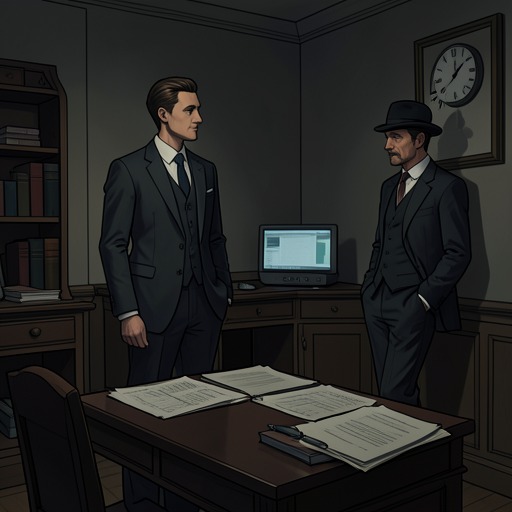
Beresfords’ covert operation as Blunt’s Brilliant Detectives
Partners in CrimeTommy Beresford and Tuppence Beresford’s covert operation as Blunt’s Brilliant Detectives begins as both a cover identity and an experiment: they revive a failing agency under the name of its detained manager, Theodore Blunt, while Tommy secretly follows instructions from Mr. Carter. Their work repeatedly turns detective fiction and everyday appearances into tools of investigation, but the danger of the performance is that identities can be counterfeited by their enemies as well as by them.
The Agency as Cover
The International Detective Agency has been on its last legs when Mr. Carter explains that an associate has acquired it cheaply and proposes reopening it for a six-month trial. The agency needs a manager, but Theodore Blunt is unavailable: Scotland Yard has intervened over his indiscretion, and he is being detained at His Majesty’s expense. Mr. Carter suggests that Tommy take six months’ leave on the pretext of ill health and run the business under Blunt’s name, formally separating the enterprise from his official position. The cover is therefore built on a useful fiction: a real agency, a real manager’s name, and a new manager whose connection to Mr. Carter is not to be disclosed.
The assignment carries a second, less public purpose. Mr. Carter tells Tommy to watch for letters with a Russian stamp, supposedly sent by a ham merchant seeking a wife who came to the country as a refugee. Moistening the stamp will reveal the number 16 written underneath. Tommy is to copy the letters, forward the originals to Mr. Carter, and report immediately if anyone refers at the office to No. 16. The instructions turn the agency into a listening post: its clients and correspondence may serve ordinary private inquiries, but particular details can also signal covert business. Mr. Carter leaves Tommy free to run the agency as he pleases and suggests that the work may amuse Tuppence by giving her a chance to investigate.
A Performed Workplace
A few days later, Tommy and Tuppence take possession of the agency’s offices on the second floor of a dilapidated Bloomsbury building. The arrangement gives their assumed business a material setting. Albert, formerly a Long Island butler, becomes the office boy, performing the part with inky hands, a tousled head, and a paper bag of sweets. Two doors lead from the small outer office: one marked for clerks and another for private business.
Behind the private door, Tommy plays the pseudo Mr. Blunt at a large, businesslike desk. The labeled files are artistically arranged but empty; the telephone is ready, and Tommy and Tuppence have rehearsed telephone effects, with Albert also given instructions. Tuppence works in the adjoining room at a typewriter, among less impressive furniture, with a gas ring for making tea. The office is furnished to suggest an established firm before it has clients. Its carefully staged authority is at once practical disguise and comedy: the great chief’s desk and empty files promise a scale of business that the agency has yet to achieve.
Detective Fiction as Rehearsal
Tommy treats the new work as a craft to be learned. He arranges detective novels on a cupboard shelf and describes his plan as “Half hours with the Great Masters,” intending to try different investigative styles and compare the results. Tuppence questions whether fictional methods will survive contact with real cases, pointing out that Tommy lacks the medical, legal, and scientific expertise associated with some celebrated detectives. Tommy answers with a practical adaptation: he has bought a camera to photograph footprints and enlarge the negatives. The books supply models, but the agency’s work requires them to test those models against evidence and their own limitations.
The pair also uses fiction to assign themselves roles when danger becomes immediate. After Tuppence suspects that an apparent visitor is part of a gang that has discovered Tommy is not the real Blunt, Tommy turns to the books and declares that they will be the Okewood brothers, with himself as Desmond. Tuppence elects to be Francis, whom she regards as the more intelligent brother and the one who arrives in time to save the situation. The joke makes their partnership legible as a recurring performance: Tommy chooses the exposed, imperilled role, while Tuppence claims the resourceful rescuer’s part. Their role-playing can sharpen attention, but it does not make them invulnerable. In one encounter, an apparent Inspector Dymchurch proves to be a foreigner whose flawless English and transformation of manner reveal that the identity had been an act; Tommy is gagged and bound.
Their allusions to famous detectives similarly mix play with method. Tuppence urges Tommy to use his “little grey cells” while he tries to understand why she has arranged a fireman’s kit and plans to wear his clothes with an American hat and horn spectacles. Later, Tommy adopts the manner of Hercule Poirot and invokes a supposed former encounter with the man who was No. 4, claiming that the supposedly dead criminal has returned as No. 16. Such performances show how readily the couple can borrow the authority of detective conventions, while keeping a distinction between theatrical confidence and what they can actually establish.
Disguise, Evidence, and Reversals
The operation’s recurring subject is identity as something read from outward signs—and manipulated through them. In an investigation involving Sir Arthur Merivale and Captain Bingo Hale, Tommy interprets an advertisement and a fragment of newspaper as evidence of a planned meeting. The phrase “Necessary to finesse the King” serves as a warning to Lady Merivale; Tommy concludes that she and Captain Hale had arranged to meet at the Ace of Spades, and that the fragment in the dead woman’s hand may match a tear in Hale’s homemade newspaper costume. But Hale denies having spoken with Lady Merivale at the show and offers a different explanation for a note. Tommy and Tuppence have seen him with her, yet the account and its physical clues still require testing. Their casework thus depends not just on spotting a suggestive detail but on comparing the claims against material evidence.
A later golf-course discussion makes the mechanics of disguise explicit. Tuppence explains that a man could pass at a distance as a woman by wearing a long brown skirt over plus fours, a brown sweater, and a felt hat with side curls; he could then remove the skirt and headwear and put on a man’s cap. The change from woman to man could take a minute and a half or less, she estimates, while changing in the opposite direction would take longer because the skirt and curls required adjustment. Such practical knowledge turns clothing into a means of controlling what witnesses believe they have seen. It also clarifies why an apparently stable description may be unreliable when a suspect has access to shelter and time to change.
Tommy’s reasoning about the diplomatic-bag case likewise begins by reversing the apparent meaning of a swap. Rather than ask why anyone would want the Ambassador’s bag for an hour, he asks why someone would want the other bag temporarily placed in the Ambassador’s possession. Because diplomatic luggage avoids Customs examination, he infers smuggling, and the need for a compact contraband leads him to suspect drugs. He also reads a staged office comedy as an attempt to distract or remove him: a woman’s alarm at Albert’s lasso performance does not fit her supposed part, while a stranger’s attack appears designed to win Tommy’s confidence in her. Tommy plays the credulous investigator, lets himself be lured to the supposed destination, and leaves full instructions behind. Here the agency’s own theatrical habits become investigative instruments: he answers deception with a deliberately performed credulity.
The Cost of the Performance
The operation’s disguises finally expose the risk built into its method. At the hotel, Tommy finds a rolled black bundle beneath a sofa. Inside the black coat Tuppence had worn are her walking dress, hat, and a long fair beard. The clothes reveal that the people Tommy had been watching for were not merely attempting to escape; they had used a prepared change of costume to remove Tuppence while disguising the identity of the person leaving. Tommy reconstructs how accomplices, including a supposed hospital nurse and a boy, had made themselves familiar to the hotel staff before carrying out the plan. Mr. Carter identifies a fragment of a hypodermic needle on the carpet, establishing that Tuppence had been drugged rather than persuaded to cooperate.
The episode gives the agency’s elaborate playacting a darker counterpart. The Beresfords use names, office furniture, detective roles, and clothing to make false identities serve investigation; their opponents use the same social trust in uniforms, gendered clothing, and familiar hotel roles to conceal an abduction. The distinction lies not in whether appearance is performed, but in who controls the performance and what evidence survives it. The agency’s continuing value rests on its ability to notice those gaps—an unexpected expression, a torn fragment, a concealed change of clothes—even as the couple’s own cover makes them vulnerable to being misread and outplayed.